Bitcoin ATM Baltimore: the honest map
Roughly 124 crypto kiosks sit inside Baltimore city limits, and they are not interchangeable. This is who runs them, which corridors they cluster on, what they charge, what ID you will be asked for, and how to spot a machine you should not use.
Kiosks charge 9–21% in this city. CEX.IO is FinCEN-registered with US money transmitter licensing (NMLS ID 1804170) and prices a fraction of that.
Ask a Baltimorean where to buy Bitcoin and the answer is usually "there is a machine in the store on the corner". They are almost certainly right. Kiosk trackers list around 124 crypto ATMs inside city limits from about ten different operators, and once you add Towson, Parkville, Essex, Dundalk and Catonsville the metro number climbs past two hundred. Very few US cities of Baltimore's size carry that kind of density.
Density is a double-edged thing. It means you are rarely more than a ten-minute drive from a machine, and it also means the market is fragmented enough that two kiosks on the same block can quote materially different prices for the same Bitcoin at the same moment. Nobody arbitrages that for you. You have to read the screen.
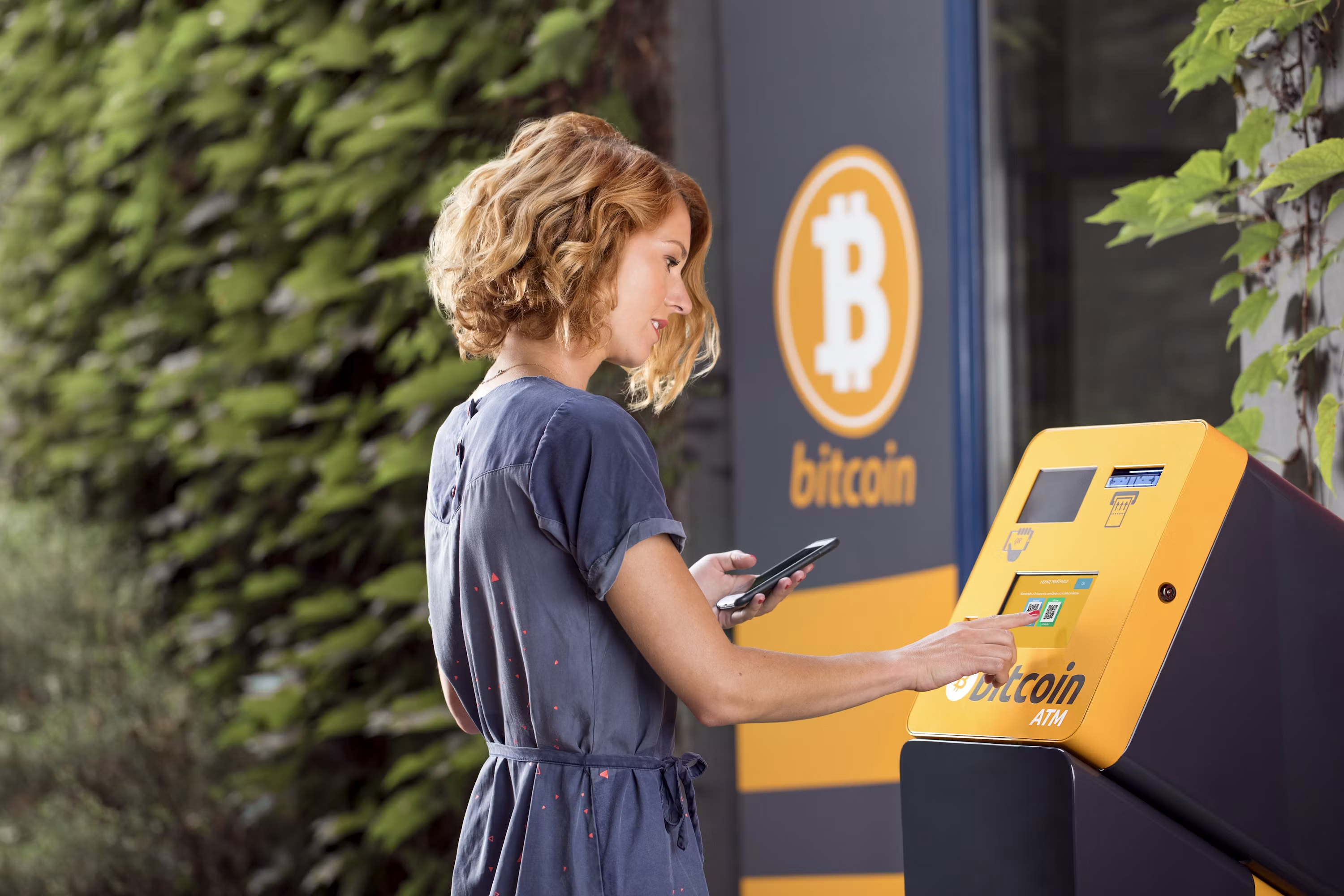
A Bitcoin ATM is not an ATM. It does not connect to a bank network or debit your account. It is a cash-accepting vending terminal wired to an operator's trading account: you feed in notes, the operator buys crypto on the back end at a marked-up rate, and it pushes coin to the wallet address you scan. Maryland regulation calls these devices virtual currency kiosks, which is the more accurate name.
Who actually runs Baltimore's machines
The fleet is dominated by two national networks, with a long tail of smaller operators. Our counts are drawn from operator location listings and public kiosk trackers in August 2026; treat them as a snapshot, because hosts swap machines constantly when a store closes or a lease ends.
| Operator | Machines | Typical host type | Notes |
|---|---|---|---|
| Bitcoin Depot | ~46 | Gas stations, convenience and grocery hosts citywide | Buy-focused, dense east and west coverage |
| Bitstop | ~39 | Convenience stores and retail counters | Second-largest fleet, many late-hour hosts |
| Coinme-powered | ~21 | Retail counters and partner terminals | Often cashier-assisted rather than free-standing |
| Athena Bitcoin | ~14 | Tobacco shops, markets, corner stores | Multi-coin support on many units |
| CoinFlip | ~6 | Tobacco, wine and spirits, vape shops | Two-way on several Baltimore units |
| Coinhub | ~6 | Convenience and liquor stores | Compact footprint, tighter cash-in caps |
| Unbank / HODL ATM | ~8 combined | Small independent retail | Smaller networks, variable uptime |
| GetCoins / others | ~4 combined | Scattered independent hosts | Worth checking screen rate before use |
The practical consequence: if you have a preferred operator because you already passed its verification, plan your trip around that network rather than the nearest pin on a map. Being verified with Bitcoin Depot does nothing for you at a Bitstop machine, and re-verifying at the counter of a busy liquor store on a Friday night is nobody's idea of fun.
The corridors where kiosks cluster
Baltimore kiosk placement follows retail footfall, not population. Machines concentrate along commercial arteries and thin out sharply in purely residential blocks. Publicly listed locations give a clear picture of the pattern.
In the south-east, Broadway through Fells Point carries kiosks in tobacco and convenience shops — a listed CoinFlip unit sits at 708 South Broadway, and there is coverage on East Fort Avenue toward Federal Hill and Locust Point. Eastern Avenue through Highlandtown is the densest comparison-shopping strip in the city; you can stand in one spot and reach three operators on foot.
Heading north, York Road and the York Road Plaza area near Govans host machines in wine and spirits shops, while Harford Road and Belair Road carry a chain of units running out through Hamilton, Overlea and into Parkville. West and north-west, Liberty Heights Avenue, Reisterstown Road and the North Avenue corridor have heavy gas-station and grocery placement — good availability, but these are the locations where we most strongly advise a daylight visit and a staffed interior.
Downtown coverage exists around Lombard Street and the Charles Street spine, though the units there skew older with tighter note-acceptance limits. South of the harbor, past Federal Hill toward Curtis Bay and Brooklyn, coverage genuinely thins — plan the trip instead of assuming a machine will appear.
County ring worth knowing about
- Towson — Putty Hill Avenue and the plazas off York Road
- Parkville / Overlea — Harford Road corridor, several networks
- Essex — Stemmers Run Road and the Eastern Boulevard strip
- Catonsville — North Rolling Road and Frederick Road
- Dundalk — Merritt Boulevard and Holabird Avenue retail
Suburban units usually mean easier parking, quieter stores and identical fee schedules. If you live near the county line, the ring is often the better trip. See the full area guide →
What Baltimore kiosks charge
Operator disclosures put kiosk fees across a wide band — one major network publishes a range of roughly 4.99% to 21.9% depending on machine, coin and direction, plus a network fee of about $2.49 to $2.99 per transaction. On Baltimore screens the numbers we see quoted most often land between 9% and 20%.
Two things inflate the real cost beyond the headline percentage. First, the exchange rate the machine uses is its own, and it is usually set a little away from the mid-market price you see on a price tracker — so the effective spread is wider than the stated fee. Second, the network fee is a flat charge, which means it hurts small purchases disproportionately: $2.99 on a $60 buy is another 5% on top of everything else.
Enter your amount and advance to the confirmation screen. It must show the exact quantity of crypto you will receive. Compare that against the live market price on your phone. If the gap is bigger than you expected, cancel — you lose nothing, and there is very likely a better machine within fifteen minutes. Full breakdown in our kiosk fee and limit guide.
Verification: what you will be asked for
The "anonymous Bitcoin ATM" is a museum piece. Every operator with a real presence in Baltimore runs tiered identity checks, and the 2026 Maryland framework has pushed documentation further into the mainstream rather than pulling it back.
-
Tier one — phone number
Mobile number plus an SMS code, sometimes your first and last name. Enough for small purchases, typically a few hundred dollars a day.
-
Tier two — government ID
Camera scan of a Maryland driver's licence, state ID or passport, plus a live selfie for liveness matching. Unlocks the middle band, commonly $1,000 to $3,000 a day.
-
Tier three — enhanced checks
Address confirmation, occupation, and questions about source of funds and purpose. Required to approach the highest caps, which reach up to $15,000 a day on some networks.
None of this is optional. Federal anti-money-laundering rules apply to kiosk operators as money services businesses, and structuring — deliberately splitting a large purchase into smaller ones across machines to stay under a threshold — is itself a federal offence. Do not do it, and be suspicious of anyone who suggests you should.
How to pick a machine you can trust
Maryland's kiosk regulations give you concrete things to look for. Operators must display signage directing consumers to the Commissioner of Financial Regulation for complaints and registration verification, on-screen disclosures must stay visible for a minimum time based on length, and receipts must carry prescribed transaction detail including fee and refund-notice instructions. A machine that fails those tests is a machine to walk away from.
- Operator name, support phone number and state complaint signage on or beside the unit
- A working printer or an emailed receipt containing rate, fee and transaction reference
- Disclosure screens you have time to read, not a flash before the cash slot opens
- Located inside a staffed, lit business — not a vestibule or an unstaffed lobby
- No stickers, overlays or taped-on QR codes anywhere near the screen or scanner
- A QR code taped to the machine that someone tells you to scan "for your wallet"
- Anyone offering to help you complete the transaction, including a stranger on the phone
- A unit with no operator branding, no receipts and no visible complaint route
- Any instruction to deposit cash to resolve a fine, warrant, tax bill or "account freeze"
When a kiosk is genuinely the right call
We are hard on kiosk pricing, but we are not against kiosks. There are situations where the premium is rational:
- You have physical cash and no bank account that will originate a transfer
- You need coin in a wallet within the hour and cannot wait for ACH settlement
- You are buying a small amount deliberately and the flat cost is acceptable to you
- You want to learn the mechanics of a wallet address with a small, contained purchase
If none of those apply, the honest recommendation is to spend twenty minutes verifying on a licensed exchange instead. It is the difference between paying $15 and paying $150 on the same $1,000.
Same Bitcoin, a fraction of the fee
A licensed exchange account takes about twenty minutes to open and pays for itself on your first purchase. CEX.IO is registered with FinCEN as a money services business and licensed as a money transmitter under NMLS ID 1804170 — verify it yourself, then decide.
Bitcoin ATM questions from Baltimore readers
Which company runs the most Bitcoin ATMs in Baltimore?
Bitcoin Depot has the largest tracked fleet inside Baltimore with roughly 46 machines, followed by Bitstop with around 39. Athena Bitcoin, Coinme-powered terminals, CoinFlip, Coinhub, Unbank, HODL ATM, GetCoins and National Bitcoin ATM make up the rest of the roughly 124 machines in the city.
Do Baltimore Bitcoin ATMs require ID?
Yes, in practice. Every major operator starts with a mobile number and SMS verification, then requires a government-issued photo ID and a live selfie once you cross their lower tier — usually a few hundred to a thousand dollars. Higher tiers can trigger source-of-funds questions.
Can I sell Bitcoin for cash at a Baltimore kiosk?
Only at two-way machines, and they are a minority of the fleet. Most Baltimore units are buy-only. Two-way kiosks typically issue a redemption code you take back to the machine or the host counter, and sell-side markups are often wider than buy-side.
What are the daily limits at Baltimore crypto ATMs?
Limits are tiered by verification level and set per operator. Entry tiers are commonly a few hundred dollars a day, mid tiers land in the $1,000 to $3,000 range, and fully verified users at some networks can reach up to $15,000 per day. Individual machines can be capped lower by the host.
Are the machines registered with Maryland?
They must be. Maryland virtual currency kiosk operators fall under the state registration framework that applies from 1 January 2026, with the implementing regulations effective 30 March 2026 requiring signage that tells consumers how to verify registration and file complaints with the Commissioner of Financial Regulation.