
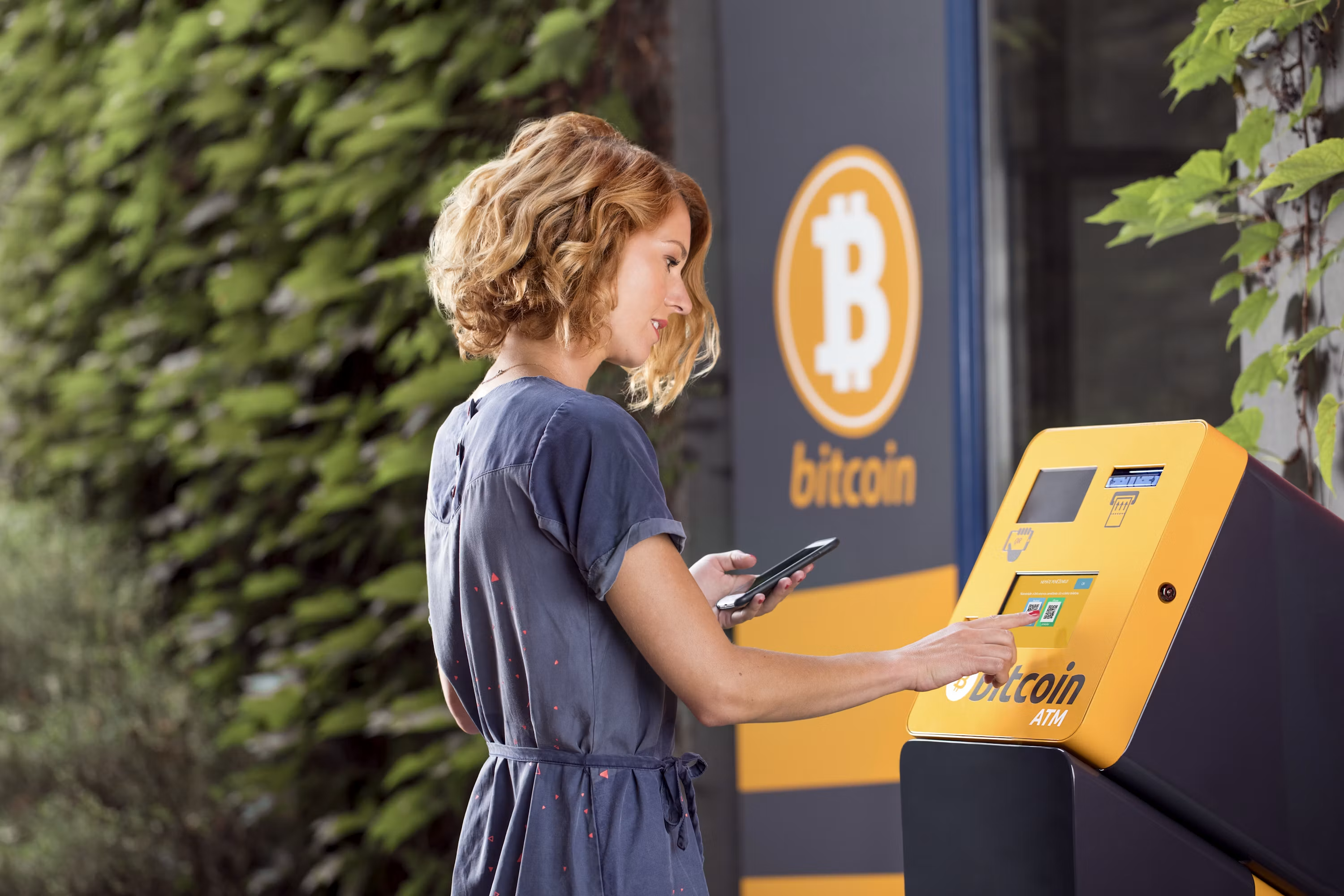
Bitcoin ATM Fees in Baltimore
Not the marketing number — the number that comes out of your purchase. Markups by operator, the flat network fee nobody mentions, how verification tiers set your daily ceiling, and what $100, $500 and $2,000 actually buy at a Baltimore machine.
A licensed exchange charges a small fraction of kiosk pricing. CEX.IO is FinCEN-registered with US money transmitter licensing (NMLS ID 1804170).
Kiosk pricing is the least transparent thing in local crypto, and not by accident. There are three separate charges stacked on a single purchase, they are disclosed in different places, and only one of them is the number people quote. Once you can see all three, choosing between machines in Baltimore becomes straightforward.
1. The markup
A percentage the operator adds to the price. Published ranges run from about 4.99% to 21.9% depending on machine, coin and whether you are buying or selling.
2. The network fee
A flat charge for the on-chain transaction, typically $2.49 to $2.99. Independent of size, so it punishes small purchases severely.
3. The rate spread
The machine uses its own reference price, usually set a little away from mid-market. This is the charge nobody advertises, and it is why the confirmation screen matters.
Ignore percentages at the machine. Look at the exact quantity of crypto the confirmation screen says you will receive, multiply it by the live price on your phone, and compare with the cash you are about to insert. The difference is your true all-in cost. Everything else is marketing.
Fee bands by operator in Baltimore
Operators set pricing per machine, so a single network can charge differently on two units a mile apart. The bands below are our observed range across Baltimore-area machines and public disclosures — treat them as a shopping guide, not a quote.
| Operator | Buy markup band | Network fee | Two-way? | Notes |
|---|---|---|---|---|
| Bitcoin Depot | High teens | Flat, ~$3 | Rarely | Largest local fleet; app registration can improve terms |
| Bitstop | Low-to-mid teens | Flat | Rarely | Second-largest fleet, many late-hour hosts |
| CoinFlip | ~5%–22% published range | $2.49–$2.99 | Some units | Daily limits up to $15,000 on verified accounts |
| Athena Bitcoin | Mid teens | Flat | Some units | Multi-coin support on several Baltimore machines |
| Coinme-powered | ~7%–13% | Varies | No | Cashier-assisted; usually the mildest cash markup |
| Coinhub & smaller networks | Mid-to-high teens | Flat | Varies | Check the screen carefully; uptime is less consistent |
Worked examples: what you actually receive
Three realistic Baltimore purchases at a 15% markup plus a $2.99 network fee, compared with a licensed exchange at 1% funded by bank transfer. No sleight of hand — just arithmetic.
| Cash in | Kiosk value received | Effective cost | Exchange value received |
|---|---|---|---|
| $100 | ~$82.46 | 17.5% | ~$99.00 |
| $500 | ~$422.46 | 15.5% | ~$495.00 |
| $2,000 | ~$1,697.01 | 15.1% | ~$1,980.00 |
Two patterns fall out of that table. First, the flat network fee makes small purchases disproportionately bad — a hundred-dollar buy loses nearly a fifth of its value. Second, the percentage gap barely improves as you scale, so "buying bigger to get a better deal" does not work at a kiosk the way it does on an exchange with volume tiers. On a $2,000 purchase the difference between the two routes is roughly $283.
Cash with no banking option. A transfer that genuinely cannot wait a day. A small, deliberate first purchase to learn the mechanics. Outside those three cases, the premium is buying you nothing you could not get for a twentieth of the price.
Why the same operator charges differently across town
This confuses people more than any other part of kiosk economics, so it is worth explaining properly. Kiosk pricing is not set nationally. It is set per machine, and it reflects what that specific unit costs to run: the rent the host charges for floor space, how often an armoured service has to collect cash from that address, the insurance loading for the location, and how many transactions the machine does in a month. A unit in a busy Highlandtown shop doing forty transactions a week can be priced more keenly than an identical machine in a quiet store off Reisterstown Road doing four, because the fixed costs are spread across more volume.
There is a second, less charitable factor: local competition. Where three operators sit within a few blocks, prices tend to compress. Where a machine is the only option for a mile in any direction, they do not. That is ordinary retail economics, and it is exactly why we keep pushing readers to check two screens rather than one. The corridors where comparison is easiest are mapped in our area guide.
None of this is hidden or improper — it is simply not advertised. The operator has no obligation to tell you that its machine four blocks away is cheaper this week, and the app will not volunteer it either. That job falls to you, and it takes about ten minutes.
Fees you will not see on a fee page
Three costs sit outside the published schedule and quietly widen the gap between what you expect and what lands in your wallet.
The reference rate. The machine prices from its own feed, typically set a little away from the mid-market price a public tracker shows you. On a volatile afternoon that gap can widen further, because the operator is pricing in the risk of the market moving between your deposit and its own hedge. Nothing improper about it — but it means a machine advertising "12%" can cost you fourteen or fifteen in practice.
Quote expiry and re-quoting. The rate you are shown is held for a window. If you spend three minutes fishing notes out of a wallet, or the on-chain network is congested and confirmation is slow on a sell, you may be re-quoted at a worse level. Have your cash counted and your wallet QR code open before you start.
Withdrawal from a custodial balance. Some cashier-assisted and app-based flows credit crypto to an operator-held balance rather than sending it straight on-chain. Moving it to your own wallet later can carry its own withdrawal fee. Read that step before you commit, or you will pay the network twice.
Limits and verification tiers
Your ceiling is not a property of the machine, it is a property of your account with that operator. This catches people out constantly: you can be fully verified with one network and start from zero at a machine one block away.
| Tier | What you provide | Typical daily ceiling |
|---|---|---|
| Entry | Mobile number, SMS code, name | A few hundred dollars |
| Standard | Photo ID scan plus live selfie | $1,000–$3,000 |
| Enhanced | Address, occupation, source of funds | Up to $15,000 at some networks |
Note the difference between a daily limit and a cash-in limit. A machine advertising a $15,000 daily ceiling may accept only a few hundred dollars of notes per session because of the physical capacity of its cash box, and older downtown units reject worn bills readily. Plan for multiple sessions on larger amounts — but never split a purchase across machines to stay under a reporting threshold. That is structuring, and it is a federal offence in its own right.
Five ways to pay less at a Baltimore machine
- Shop the corridor — quoted markups differ by several points within a short walk in Highlandtown or along Belair Road
- Register in the operator's app before you travel; some networks price registered users better
- Consolidate purchases so the flat network fee is spread across a larger amount
- Prefer cashier-assisted retail flows for small cash amounts — the markup band is usually milder
- Compare the confirmation screen against live market price every single time, and cancel freely
What Maryland now requires operators to disclose
Under the state's virtual currency kiosk regulations effective 30 March 2026, on-screen disclosures must remain visible for a minimum period scaled to their length, receipts must contain prescribed transaction detail including fee information and fraud-refund instructions, and each kiosk must carry signage pointing you to the Commissioner of Financial Regulation to verify registration or file a complaint. If a machine rushes its disclosures or cannot produce a receipt, that is a reportable problem — see our regulation guide.
Or pay a rounding error instead
The same Bitcoin on a licensed exchange, funded from your Maryland bank account, costs a fraction of every number on this page. CEX.IO is FinCEN-registered and licensed as a money transmitter under NMLS ID 1804170.
Fee questions
How much do Bitcoin ATMs charge in Baltimore?
Published operator ranges span roughly 4.99% to 21.9% depending on machine, coin and direction, plus a network fee of about $2.49 to $2.99. On Baltimore screens the numbers we see most often sit between 9% and 20%, and the effective cost is a little higher again because the machine uses its own exchange rate.
Why are crypto ATM fees so high?
Cash is expensive to handle. The operator pays host rent, armoured collection, insurance, compliance staff, licensing and fraud losses, all against a machine that may do a handful of transactions a day. That is a real cost structure — it just means you should choose the premium deliberately rather than by default.
What is the daily limit at a Baltimore Bitcoin ATM?
Limits are tiered. Phone-only verification typically allows a few hundred dollars a day, ID plus selfie moves you into the $1,000 to $3,000 range, and enhanced verification can reach up to $15,000 a day at some networks. Individual machines are often capped lower by the operator or the host.
Is the network fee the same as the markup?
No. The markup is the operator’s percentage on the exchange rate. The network fee is a flat charge covering the on-chain transaction, usually around $2.49 to $2.99. Because it is flat, it hits small purchases hardest — nearly 6% on a $50 buy before the markup applies at all.
Can I negotiate or reduce kiosk fees?
Not at the machine. What you can do is shop between operators — quoted rates differ by several percentage points within a single Baltimore corridor — register in the operator app in advance where a promotional rate is offered, and consolidate purchases so the flat network fee is spread across a larger amount.